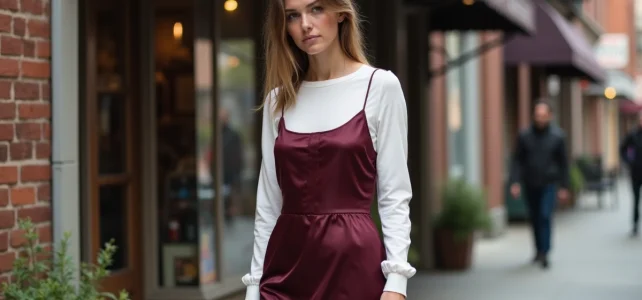
Open a women’s magazine from 1995 and you’ll find a mix that, thirty years later, still has no equivalent: a satin slip dress worn with chunky-soled boots, cargo pants paired with a fitted top, a tailored jacket thrown over a sportswear logo t-shirt.
The women’s fashion of 1995 was neither just grunge nor minimalism. It existed at their point of collision, with pieces that circulated as easily on Parisian runways as in the streets of Brooklyn.
Materials and utilitarian cuts: the true foundation of the 1995 wardrobe
We often talk about the glamorous or grunge silhouettes of that year, but everyday dressing relied on much more functional pieces. The ripstop cotton cargo, the nylon bomber, the high-waisted straight-leg jeans: these garments came from military surplus or sportswear and were found everywhere, from high school courtyards to parties.
Streetwear began to infiltrate luxury exactly at that moment. Fashion houses incorporated visible logos, technical materials, and oversized cuts into their collections, blurring a boundary that had seemed clear just two or three years earlier. This shift structured codes that remain active in current fashion.
To delve deeper into this panorama, you can find women’s fashion from 1995 on Aleph Zarro with a detailed inventory of the pieces and silhouettes that defined that year.
The uniqueness of the utilitarian wardrobe of 1995 is that it wasn’t gendered in the same way as today. Women borrowed from the men’s wardrobe without it being a conspicuous militant act. One wore cargo pants because they were practical, not to make a statement. This nonchalance clearly distinguishes the style of 1995 from contemporary reinterpretations, which are often more conceptualized.
Satin slip dress and minimalism: the fine line of 1995 glamour
The satin slip dress, often worn alone or over a long-sleeved t-shirt, remains the most immediate visual symbol of 1995. It embodies a minimalism that was anything but austere: fluid lines and lightweight materials replaced any decorative overload.
This minimalist trend coexisted with more structured glamorous and femme-fatale references. The archives of runway shows from that year show that several fashion houses drew from the codes of the 1950s, with fitted silhouettes, intricate necklines, and luxurious fabrics. Le Monde even described the haute couture of summer 1995 as being “under the sign of the 1950s.”
How the slip dress was really worn daily
On the runways, the slip dress appeared alone, with heels and bold makeup. In the street, the reality was more improvised. It was layered over a black turtleneck in winter, belted with a leather belt, worn with white sneakers on weekends.
Layering defined the style of 1995 as much as the pieces themselves. A satin camisole under a suit jacket, a shirt open over a fitted tank top: these combinations created a contrast of registers that gave the look its tension.
Platform shoes and black leather accessories: the fashion markers of 1995
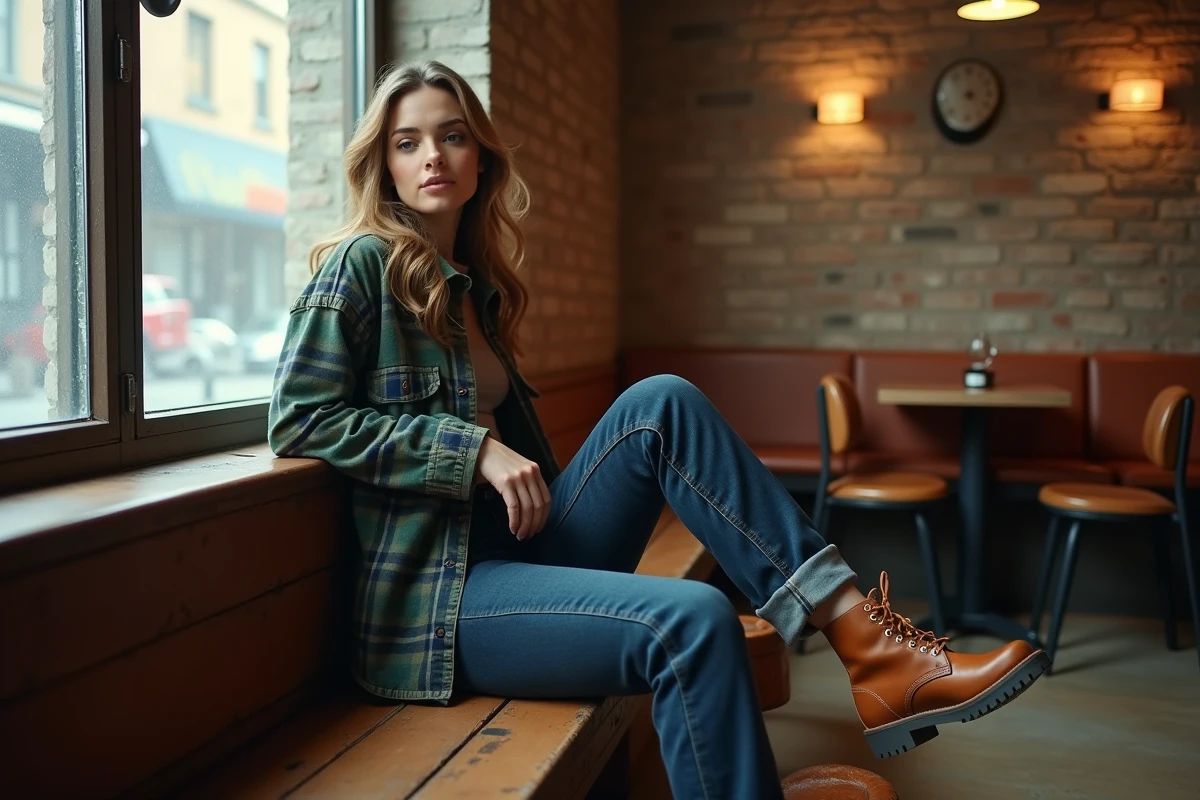
Talking about 1995 without mentioning platform shoes would overlook a whole aspect of the wardrobe. Thick soles came in sandals, boots, and loafers. They radically altered the silhouette and paired well with both a flowing dress and jeans.
- Black leather platform boots, often with square toes, worn with midi skirts or slip dresses for a contrast between heavy and light.
- Medium-sized black leather handbags, structured, with visible metal buckles, worn on the shoulder or with a short crossbody strap.
- Wide leather belts, used to cinch the waist on oversized pieces or to break the fluidity of a dress.
- Velvet or silver metal chokers, a signature accessory that appeared in almost every photo of the time.
Black largely dominated the accessory palette. Brands played with textures (matte leather, patent leather, velvet, metal) rather than color to create variety.
Pop culture and Parisian runways: who really dictated style in 1995
Designers had a structuring role. John Galliano, Alexander McQueen, Vivienne Westwood, Jean Paul Gaultier, and Dries Van Noten offered strong and divergent visions. Thierry Mugler and Hussein Chalayan explored a futurism that integrated innovative materials and science fiction-inspired silhouettes.
Pop culture weighed in just as heavily. The Spice Girls, Gwen Stefani, Kate Moss, and RuPaul imposed fashion codes that millions of women adopted without waiting for magazine validation. Kim Gordon launched her brand X-Girl, anchoring women’s fashion in skate and underground culture.
The circulation between street and runways
What distinguishes 1995 from other fashion eras is the speed at which influences circulated between the street and the runways. A look spotted in an MTV video could appear in a haute couture collection the following season, and vice versa. Returns on this point vary by source, but this porosity seems to have been faster in 1995 than at the beginning of the decade.
This dynamic explains why the 1995 wardrobe remains so easy to reinterpret today. Pieces from 1995 still work because they never belonged to any rigid category. A cargo, a slip dress, a platform: each element can be extracted from its original context and integrated into a current outfit without looking costume-like.
The return of mid-90s silhouettes observed in recent seasons confirms this compatibility. Recent collections favor fluid minimalism and utilitarian cuts over grunge alone, indicating that fashion retains from 1995 its diversity more than its clichés.