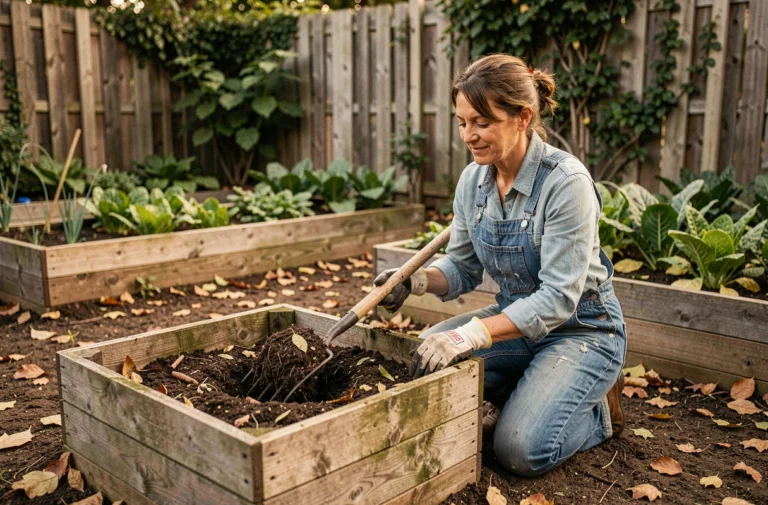
Brittany has been producing its own clothing codes for centuries, from bigouden headdresses to sailor shirts. Today, this textile identity is undergoing a transformation driven by a linen sector in reconstruction, festivals that blend haute couture and local know-how, and designers trained in the most prestigious schools in Europe. The landscape of Breton fashion is no longer limited to a few historic brands or a frozen folklore.
Breton Linen and Textile Reindustrialization: What’s Happening in Lampaul-Guimiliau
Linen is the emblematic material of Breton fashion, but the most significant changes are occurring upstream, in cultivation and processing. In Lampaul-Guimiliau, in Finistère, an old industrial wasteland is hosting a project for the transformation of textile linen. The sector relies on a network of Breton producers and plans to increase its processing capacity by 2028.
This reindustrialization changes the game for local creators. Until now, linen grown in Brittany was almost entirely sent to Asia to be spun and woven before returning as finished garments. Having local processing capacity would shorten this loop and allow for pieces whose traceability could be verified from the field to the workshop.
For brands that claim a Breton identity, the question of linen is no longer just aesthetic. It becomes industrial. Among the players involved in this regional dynamic, the fashion offered by Jolie Breizh illustrates how contemporary pieces can carry this textile identity without being limited to the cliché of the sailor shirt.
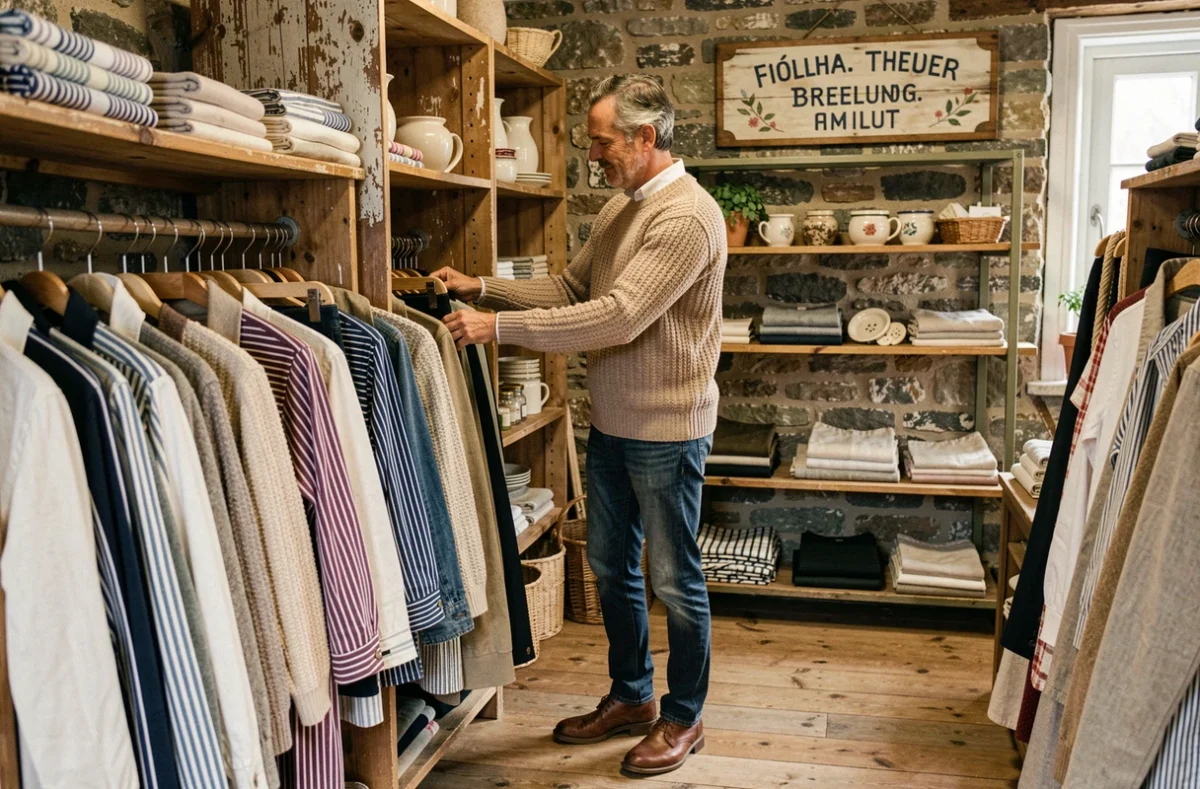
MOD Festival in Quimper: When Dior Meets Breton Embroidery
The Cornouaille festival now hosts an event dedicated to fashion, called MOD. Its principle: to connect creators who have worked with houses like Dior, Chanel, or Louis Vuitton, or trained at Central Saint Martins and ESMOD, with ancient Breton techniques, materials, and garments.
Six young designers recently reinterpreted Breton textiles during a fashion show in Quimper, starting from heritage pieces (embroidered vests, aprons, hemp fabrics) to produce contemporary silhouettes. The exercise is not merely decorative. It raises a methodological question: how to integrate traditional embroidery into a current cut without making it museum-like.
Field feedback diverges on this point. Some artisans believe that the decontextualization of Breton motifs strips them of their meaning. Others see these intersections as a way to transmit gestures that are disappearing due to a lack of carriers. The MOD festival has the merit of making this debate visible, rather than leaving it in the backstage of workshops.
From Fest-Noz to the Catwalk: A Journey That Is Anything but Obvious
Nolwenn Faligot, a stylist trained in the Celtic circle of Plougastel from the age of seven, embodies this transition between danced heritage and contemporary creation. Her journey shows that Breton fashion does not originate in a Parisian trend office. It is rooted in a bodily practice (dance, wearing costumes) that provides a physical understanding of clothing.
This link between movement and textile remains a distinctive marker. A garment designed for dancing does not fall like a garment designed for a runway, and this difference in cut increasingly interests creators who are seeking alternatives to standardized silhouettes.
Textile Reuse and Training: The Locminé-Vienne Project
A recent exchange between young fashion specialists from Vienna (Austria) and the Locminé hub (Morbihan) illustrates a less publicized trend. Participants worked with clothing and fabrics donated by Retritex, a textile collection and sorting organization, to create costumes inspired by Breton traditions.
Textile recovery serves here as an educational tool, not just a marketing argument. Young creators learn to cut from constrained materials (dimensions, textures imposed by the donation) rather than from a new roll. This constraint alters the design process and produces results that the traditional circuit does not generate.
- The recovered fabrics impose adaptive pattern-making, where each piece is unique by necessity and not by aesthetic choice
- The European exchange allows for a confrontation between Breton costume techniques and Austrian clothing traditions, creating documented hybrids
- The project demonstrates that a concrete articulation between reuse, transmission of know-how, and professional training is possible outside the circuit of grandes écoles
Identifying an Authentic Piece of Breton Fashion: Concrete Criteria
In the face of the proliferation of brands claiming a Breton identity, distinguishing a product rooted in the territory from a mere branding exercise requires some benchmarks.
- The material: linen grown and processed in Brittany (or at least in France) differs from imported linen. The mention of the fiber’s origin is a more reliable indicator than the label “made in Brittany”, which may only cover the final assembly
- The technique: embroideries done by hand or on locally operated industrial embroidery machines. Breton motifs (hermoines, triskells, interlacing) copied by digital printing on synthetic fabric have nothing in common with textile work
- The distribution circuit: brands that sell directly from Brittany (physical shops, markets, their own websites) generally assume greater transparency about their production chain than those distributed solely via marketplaces
These criteria do not guarantee the aesthetic quality of a piece, but they allow for situating a purchase within a production reality rather than within a narrative.
Breton fashion finds itself at a crossroads where linen reindustrialization, training through reuse, and contemporary creation nourished by heritage coexist. The available data does not allow for conclusions about the economic sustainability of all these projects, but their convergence in the same territory, within a few years, constitutes a new fact that the rest of the French textile sector observes with attention.