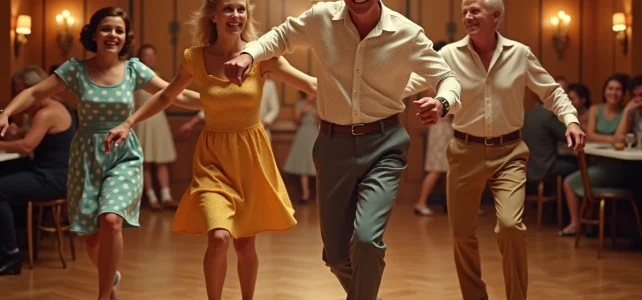
Have you ever seen a dance floor fill up in seconds as soon as the first notes of a Madison play? This phenomenon is due as much to the choice of the song as to how the choreography adapts to the space and the audience. Finding the right music to dance the Madison is primarily about understanding what makes a track effective: a steady tempo, a repetitive structure, and an energy that naturally encourages people to get up.
Tempo and musical structure of the Madison: what makes a track work
The Madison relies on a line dance choreography. Each dancer performs the same steps at the same time. To keep the group synchronized, the track must offer a stable tempo, without acceleration or breaks in rhythm.
A good Madison track generally sits around 120 to 130 beats per minute. Below that, the steps drag and the energy drops. Above that, beginners quickly lose track.
The ideal structure alternates verses and choruses in a predictable way. Dancers anticipate changes in direction thanks to musical cues: a brass rise, a drum break, a recurring guitar riff. If you’re looking for the best music to dance the Madison, focus first on this rhythmic regularity before considering the musical style.
A track with an unstable tempo clears the floor faster than an unknown title. This is the first rule of selection.
Madison in a small reception hall: adapting the dance to a limited space
Why this topic? Because most wedding or private party events take place in venues where the available space does not exceed a few dozen square meters once the tables are set up. The classic Madison, with its lateral movements and forward steps, requires space. On a narrow floor, dancers bump into each other and give up.

The solution involves two complementary adjustments: the choice of the song and the adaptation of the choreography.
Reduce the amplitude without breaking the step
In confined spaces, favor tracks with a slightly lower tempo. A moderate rhythm allows for shorter lateral steps without the feeling of shuffling. Modernized accordion versions, popular in wedding entertainment, often provide this slightly more laid-back tempo than the original rock tracks from the 60s.
Specifically, reduce lateral movements by half. Instead of two big steps to the left, take two small steps. The movement remains visible, synchronization holds, and no one steps on their neighbor.
Staggered arrangement rather than tight rows
The other lever is spatial. Place the dancers in a staggered formation: each row is offset by half a step from the previous one. This arrangement doubles the capacity of a small floor without changing the choreography. The host can announce this formation before starting the track.
Selection of Madison tracks for a party or wedding playlist
Not all tracks are equal depending on the time of the evening. A Madison at the beginning of the evening serves as a collective warm-up. In the middle of the evening, it reignites the energy after a quieter segment. The choice of the track changes based on this goal.
Classic tracks to kick off the dance floor
The most well-known tracks in the Madison repertoire share a common point: their introduction is immediately recognizable. Guests identify the dance from the first measures and get up without being prompted.
- “Madison Time” by Ray Bryant remains the historical reference, with its clear tempo and vocal cues integrated into the track
- “Last Night” in its Madison version offers a soul vibe that works in all contexts, from weddings to village parties
- “Sur un air de madison” by Eric Bouvelle, accordion version that facilitates collective synchronization thanks to a very marked rhythm
- “Sixties Madison” by Fabien Georges, a shorter track, suitable for animated sequences led by a DJ or host
Remixed versions for a mixed audience
In recent years, remixes incorporating electro elements have appeared at retro dance festivals. These versions attract a younger audience while maintaining the choreographic structure of the Madison. They work well in the second half of the evening, when the atmosphere is already established.

The most effective approach is to alternate a classic with a modernized version. The classic reassures regulars, while the remix surprises and keeps attention.
Building a coherent Madison playlist for the entire evening
Playing three Madisons in a row is a common mistake. The Madison works better in isolated sequences, surrounded by tracks of a different style. A rock, a disco, then a Madison, followed by a French song: this alternation creates an event effect with each return of the Madison.
Here are the principles for integrating the Madison into a party or wedding playlist:
- Place the first Madison after three or four dance tracks so that the floor is already occupied
- Space each Madison at least twenty minutes apart to maintain the element of surprise
- End the Madison sequence with the most well-known track, the one everyone recognizes, to finish on a peak of collective energy
- Plan a calm transition track just after the Madison; the contrast enhances the memory of the dance
Two to three Madisons per evening are enough to leave a lasting impression. Beyond that, the dance loses its special character and participants become bored.
Adjusting volume and mixing
In a small venue, the perceived sound volume is higher than in a large hall. Lower the level slightly during the Madison so that the host can guide the steps vocally. Overly pronounced bass can mask the rhythmic cues that dancers need.
The Madison remains one of the few dances that brings together all generations on the same floor, from family weddings to disco nights. Its strength lies in the simplicity of its steps and the quality of the chosen tracks. A good Madison track is recognized by its ability to get everyone up in less than ten seconds, regardless of the age or dance level of the guests.